Broken Arrow's pest year runs on its weather. Tulsa International Airport, the nearest long-record NOAA station, averages a 93.6°F high in July and a 28.0°F low in January (NOAA 1991-2020 Climate Normals), and its first 32° freeze arrives on November 3 in an average year (NWS Tulsa). That swing from Gulf-moist summers to freezing nights sets the calendar below: termites and ants swarm in spring, mosquitoes and ticks peak from April into summer, bed bug reports climb with summer heat and holiday travel, and mice push indoors once the freezes start.
How to read this page: this site is a referral line, not a pest control company. The climate data is NOAA's official 30-year record for Tulsa International Airport, the closest station to Broken Arrow with a full 1991-2020 record. The monthly pest ratings are our summary of the cited extension, health department and research sources, not a measured index. Prices are published market ranges; the provider you reach quotes your job.
- Tulsa averages 74.0 days a year at 90°F or hotter and 71.9 nights at or below freezing (NOAA).
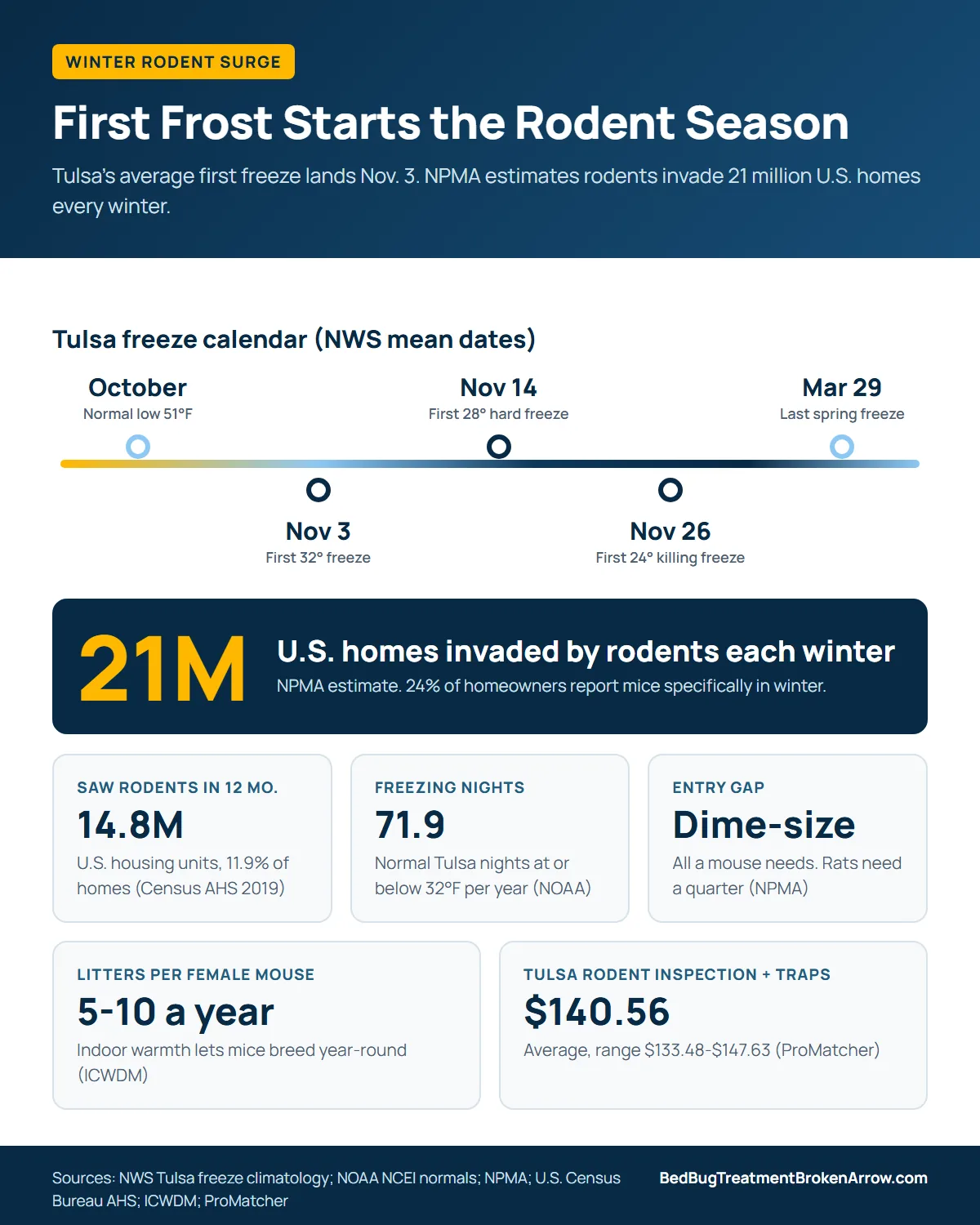
- The average first fall freeze is November 3, the first hard freeze November 14 and the last spring freeze March 29 (NWS Tulsa).
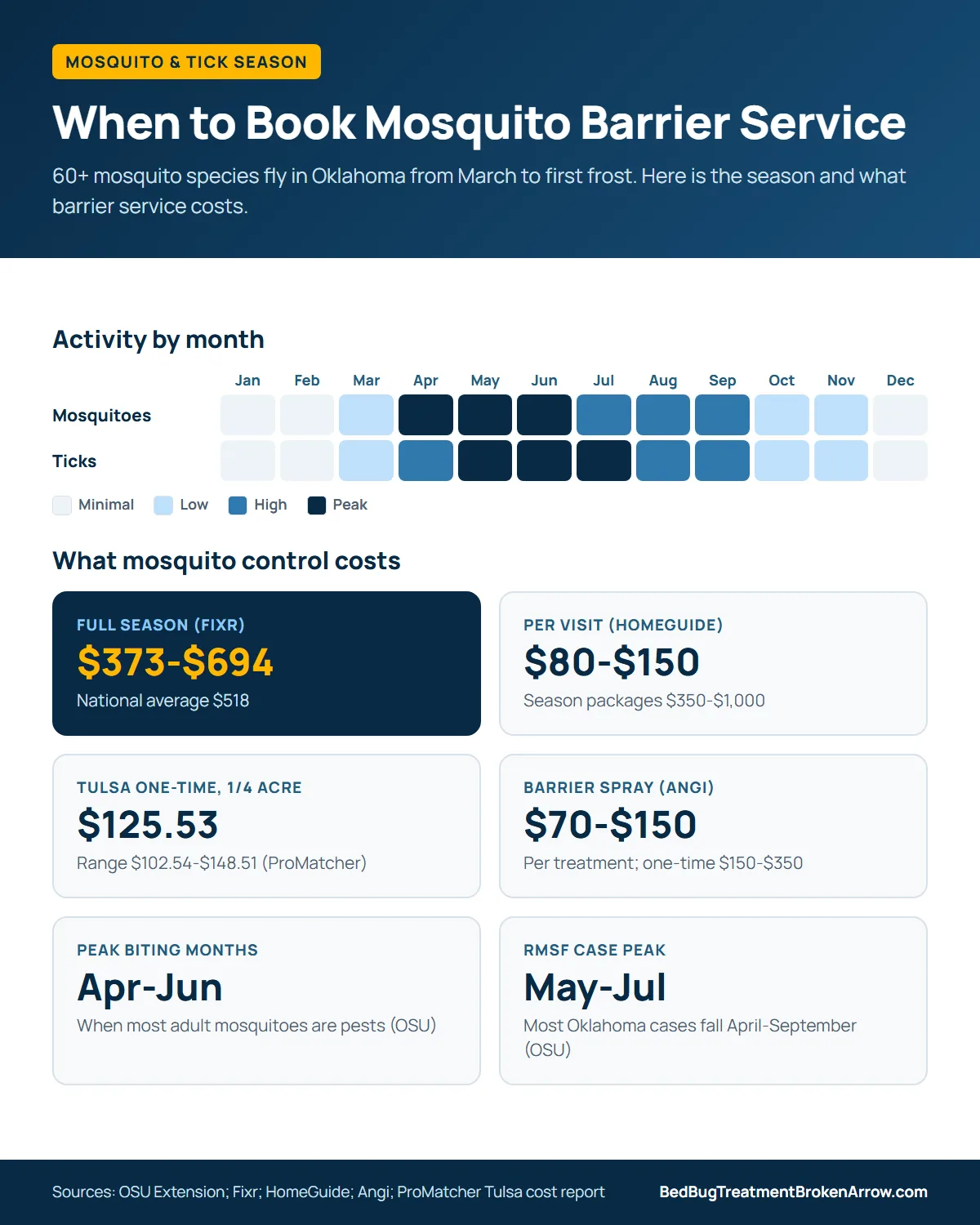
- More than 60 mosquito species occur in Oklahoma from March to first frost, and most adult mosquitoes are pests in April, May and June (OSU Extension).
- Full-season mosquito control costs $373-$694, with a $518 national average (Fixr); single visits run $80-$150 (HomeGuide).
- A one-time mosquito treatment for a quarter-acre Tulsa yard averages $125.53 in local reports dated 2018-2021 (ProMatcher).
- Most Oklahoma Rocky Mountain spotted fever cases occur April-September, peaking May-July (OSU Extension).
- Oklahoma had the highest reported ehrlichiosis rate in the U.S., 30.9 cases per million person-years, in a CDC study of 2008-2012 (Heitman et al.).
- Subterranean termites swarm in Oklahoma in March, April and May (OSU Extension).
- 95.6% of probable brown recluse bites in a Missouri-Oklahoma clinical study happened April-October (Rader et al.).
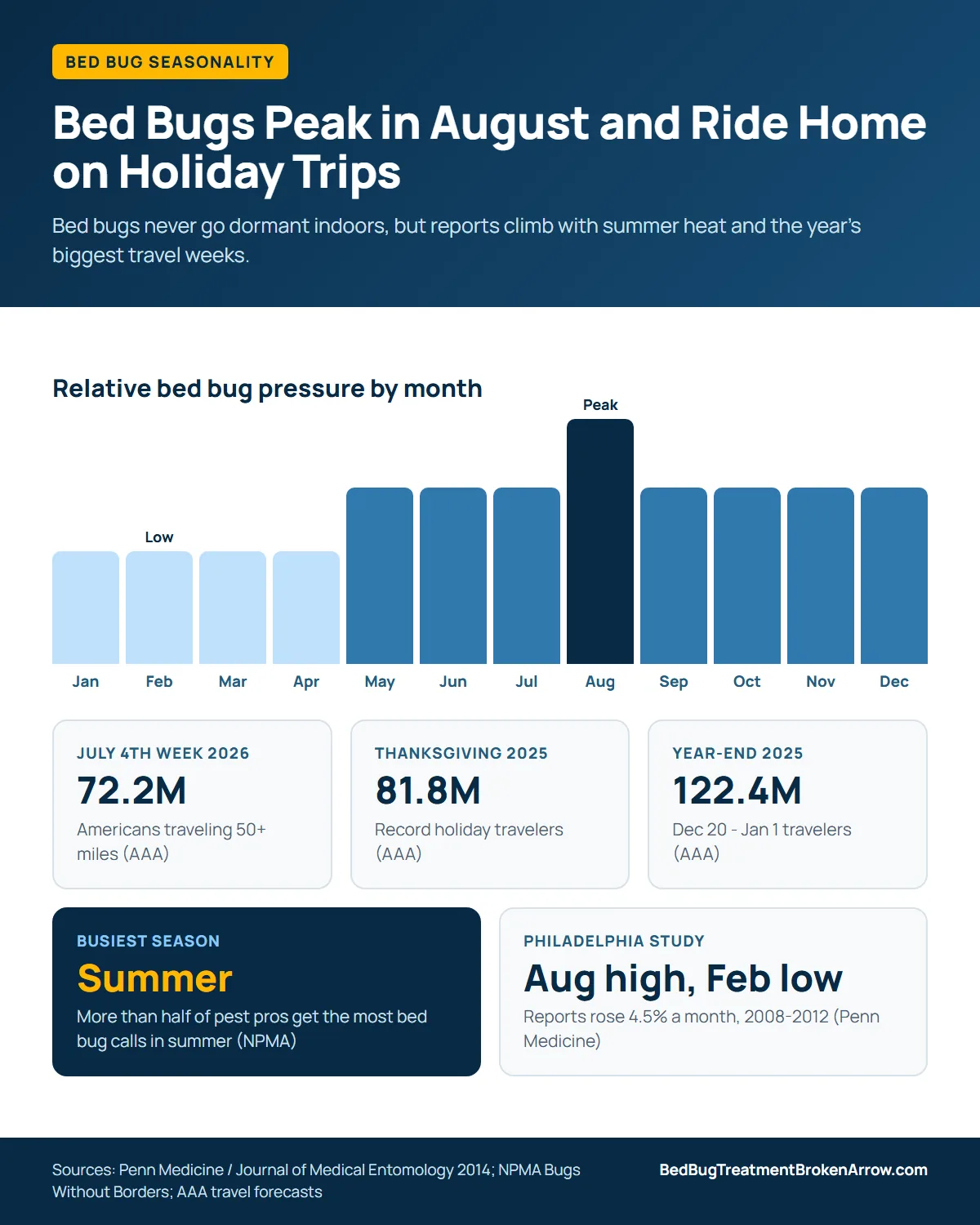
- Bed bug reports peaked in August and bottomed out in February in a five-year Philadelphia study (Penn Medicine via PCT).
- More than half of pest professionals get the most bed bug complaints in summer (NPMA).
- A record 81.8 million Americans traveled over Thanksgiving 2025 and 122.4 million over the year-end holidays (AAA).
- Rodents invade an estimated 21 million U.S. homes each winter, and 24% of homeowners report mice specifically in winter (NPMA).
- 14.8 million U.S. homes, 11.9%, saw rodents in the past 12 months (U.S. Census Bureau).
1. Broken Arrow 12-Month Pest Pressure Matrix
The matrix lines up NOAA's monthly climate normals for Tulsa International Airport with the months each pest is most active, according to OSU Extension, NPMA, the Tulsa Health Department and published research. The climate rows are official averages; the pest ratings (Minimal, Low, High, Peak) are our reading of the sources linked in each section below.
| Month | Jan | Feb | Mar | Apr | May | Jun | Jul | Aug | Sep | Oct | Nov | Dec |
|---|---|---|---|---|---|---|---|---|---|---|---|---|
| Avg high (°F) | 48.9 | 54.0 | 63.3 | 72.1 | 79.7 | 88.4 | 93.6 | 93.0 | 84.8 | 73.6 | 61.4 | 50.9 |
| Avg low (°F) | 28.0 | 31.7 | 40.7 | 49.5 | 59.5 | 68.7 | 73.1 | 71.5 | 62.8 | 50.9 | 39.4 | 31.1 |
| Humidity (%) | 68 | 65 | 63 | 62 | 70 | 70 | 64 | 65 | 69 | 68 | 68 | 70 |
| Freeze nights | 21.5 | 15.5 | 6.8 | 1.1 | 0 | 0 | 0 | 0 | 0 | 0.7 | 8.0 | 18.3 |
| Mosquitoes | Minimal | Minimal | Low | Peak | Peak | Peak | High | High | High | Low | Low | Minimal |
| Ticks | Minimal | Minimal | Low | High | Peak | Peak | Peak | High | High | Low | Low | Minimal |
| Termite swarms | Minimal | Minimal | Peak | Peak | Peak | Minimal | Minimal | Minimal | Low | Low | Minimal | Minimal |
| Ant swarms | Minimal | Minimal | High | Peak | Peak | High | Low | Low | Low | Low | Minimal | Minimal |
| Wasps & yellowjackets | Minimal | Minimal | Minimal | Low | Low | High | High | Peak | Peak | High | Minimal | Minimal |
| Brown recluse | Minimal | Minimal | Low | High | High | High | High | High | High | High | Low | Minimal |
| Cockroaches | Low | Low | Low | Low | High | Peak | Peak | Peak | Peak | High | Low | Low |
| Bed bugs | Low | Low | Low | Low | High | High | High | Peak | High | High | High | High |
| Fall invaders | Minimal | Minimal | Low | Minimal | Minimal | Minimal | Minimal | High | Peak | Peak | High | Low |
| Rodents indoors | Peak | High | Low | Low | Minimal | Minimal | Minimal | Minimal | Low | High | Peak | Peak |
Climate: NOAA NCEI 1991-2020 normals and the 2023 Local Climatological Data for Tulsa (humidity is the normal daily mean). Pest ratings: our summary of the sources cited in sections 4-11.
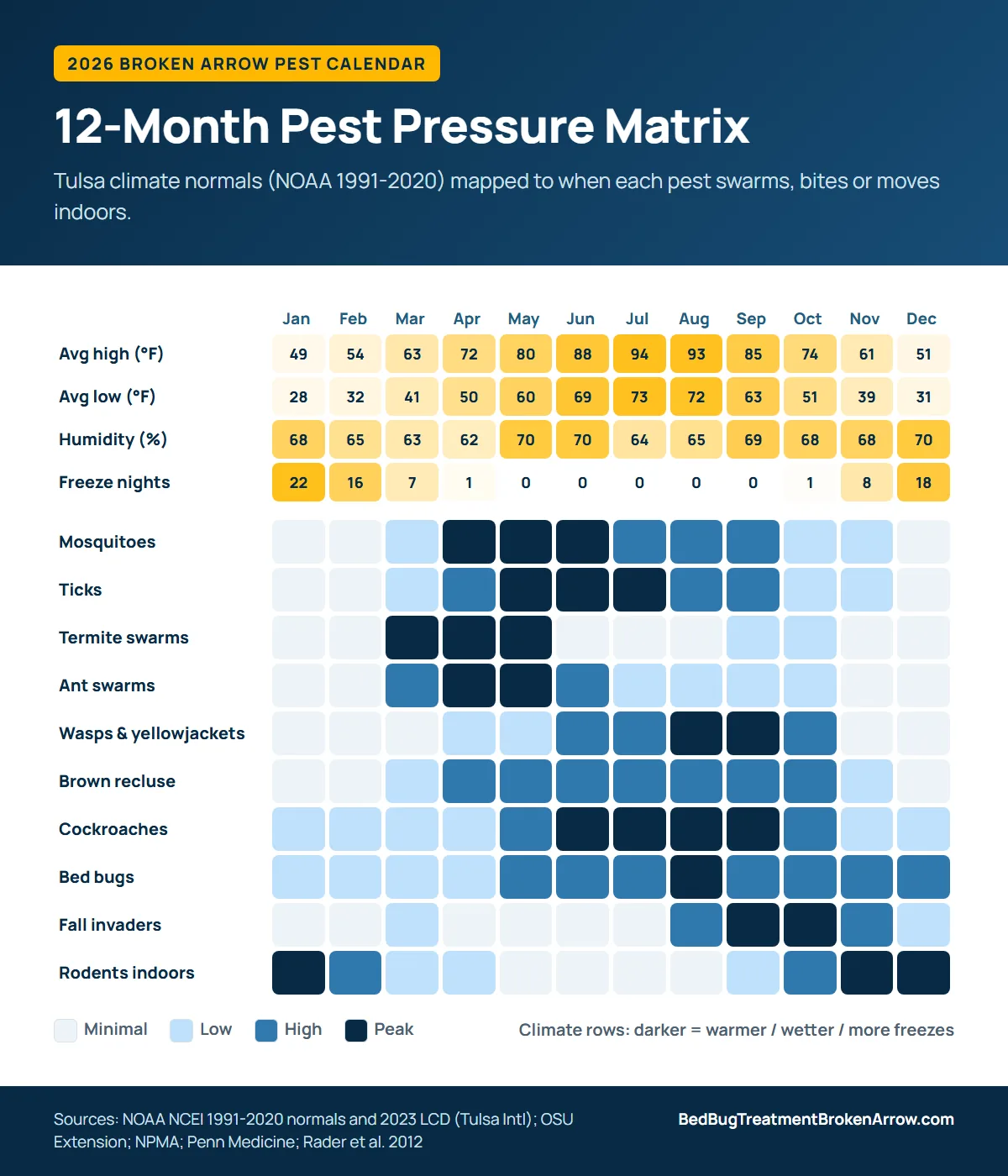
The pattern is simple. Spring (March-May) is swarm season, early summer is biting season, late summer is when stinging insects, roaches and bed bug reports peak, fall brings crickets and lady beetles to the walls, and the first freezes in November start the rodent season. Bed bugs are the one pest on the list that never leaves: they live inside heated and cooled homes all year, which is why a Broken Arrow bed bug inspection makes sense in any month.
2. Broken Arrow Climate Normals: The Weather Behind the Pests
Broken Arrow has no NOAA normals station of its own, so this guide uses Tulsa International Airport (station USW00013968), the closest first-order station with a full 1991-2020 record. Insects are cold-blooded, so these temperature and humidity swings set how fast they develop, when they fly and when they look for shelter indoors.
| Month | Avg high | Avg low | Mean temp | Humidity (6 a.m. / mean) | Rain (in.) | 90°F+ days |
|---|---|---|---|---|---|---|
| January | 48.9° | 28.0° | 38.5° | 79% / 68% | 1.63 | 0 |
| February | 54.0° | 31.7° | 42.8° | 78% / 65% | 1.62 | 0 |
| March | 63.3° | 40.7° | 52.0° | 76% / 63% | 3.10 | 0.2 |
| April | 72.1° | 49.5° | 60.8° | 78% / 62% | 4.37 | 0.4 |
| May | 79.7° | 59.5° | 69.6° | 86% / 70% | 5.73 | 3.0 |
| June | 88.4° | 68.7° | 78.6° | 86% / 70% | 4.65 | 14.2 |
| July | 93.6° | 73.1° | 83.4° | 82% / 64% | 3.76 | 24.0 |
| August | 93.0° | 71.5° | 82.2° | 83% / 65% | 3.38 | 22.2 |
| September | 84.8° | 62.8° | 73.8° | 86% / 69% | 3.85 | 9.0 |
| October | 73.6° | 50.9° | 62.3° | 83% / 68% | 3.78 | 1.0 |
| November | 61.4° | 39.4° | 50.4° | 81% / 68% | 2.66 | 0 |
| December | 50.9° | 31.1° | 41.0° | 80% / 70% | 2.43 | 0 |
Sources: temperature, rain and 90°F days from NOAA NCEI U.S. Climate Normals 1991-2020; humidity normals from NOAA's 2023 Local Climatological Data for Tulsa.
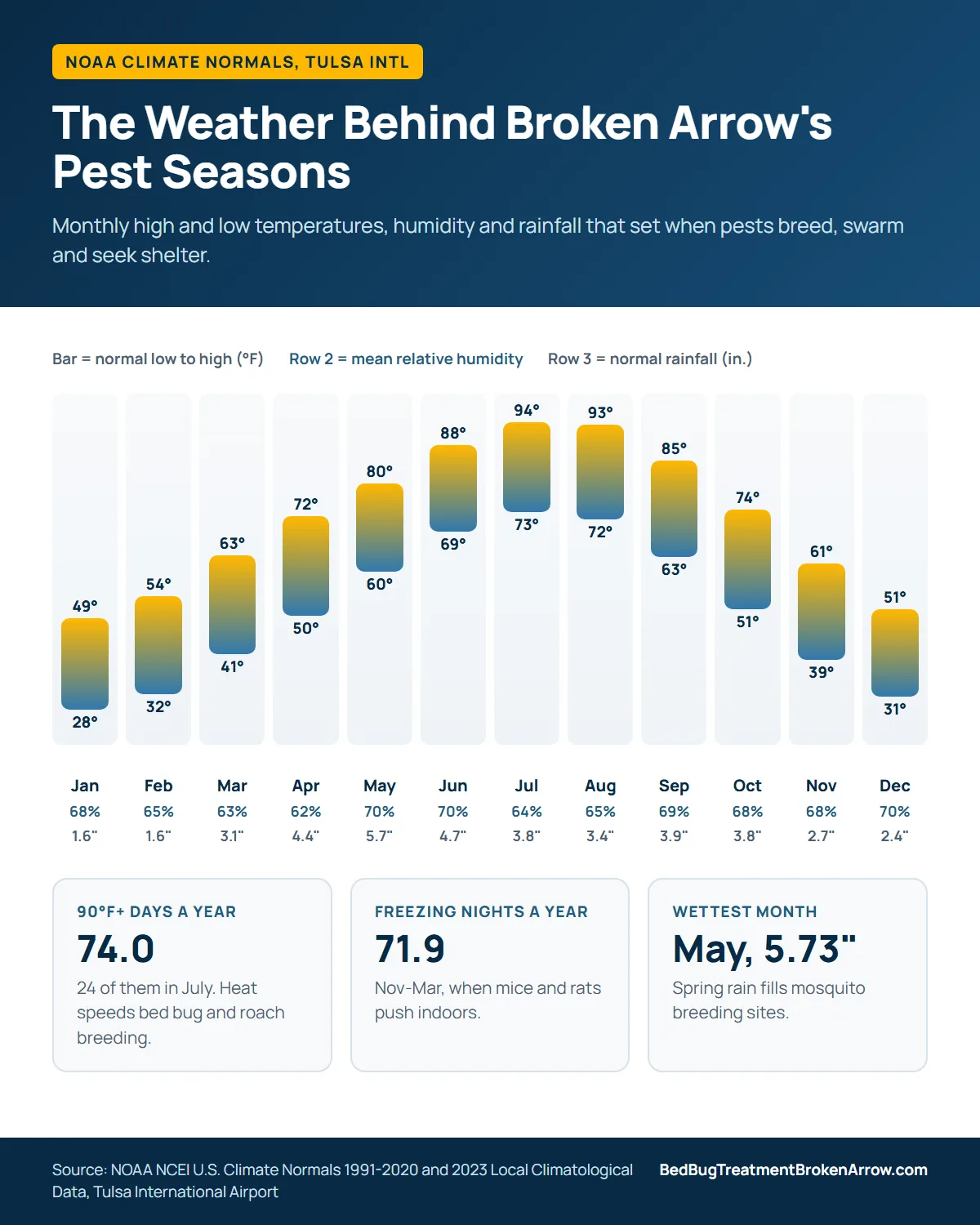
NOAA's own station summary describes Tulsa as continental with frequent warm, moist Gulf air, and names spring as the wettest season. For pests, three numbers matter most: 5.73 inches of rain in May, which fills mosquito breeding sites; 74.0 days at 90°F or hotter, which speeds insect breeding; and 71.9 nights at or below freezing, which push mice and rats indoors (all NOAA LCD).
3. The Most Common Pests in Broken Arrow, OK
National pest companies with Broken Arrow branches publish their own local pest lists. Terminix's Broken Arrow branch names termites, bed bugs, ants, cockroaches and mosquitoes as the area's most common pests, with Eastern subterranean termites as the main termite species and German and American cockroaches as the main roaches. City rankings built from treatment records show where Tulsa and Oklahoma City stand nationally.
| Ranking | Tulsa | Oklahoma City | Source |
|---|---|---|---|
| Orkin Top Mosquito Cities (treatments Mar 2025-Mar 2026) | #37 (down 5) | #26 | Orkin |
| Terminix Top Mosquito Cities (2025 service data) | #46 | #24 | Terminix |
| Terminix Top Bed Bug Cities (2026 list) | #30 | #27 | Terminix |
| Orkin Bed Bug Cities (treatments May 2025-May 2026) | Not ranked | #24 (up 10) | Orkin |
| Orkin Top Termite Cities (treatments Jan 2025-Jan 2026) | Not ranked | #30 | Orkin |
| Terminix Top Rodent Cities (2025 service data) | Not ranked | #43 | Terminix |
Federal survey data adds a household view. In the 2019 American Housing Survey, about 14 million of roughly 124 million occupied U.S. homes reported seeing cockroaches in the past 12 months and 14.8 million reported rodents, while 2.9 million saw both (U.S. Census Bureau).
Read the rankings as treatment counts, not infestation rates: a bigger metro with more branch customers ranks higher. They still show the same seasonal mix this calendar follows. Mosquitoes and termites are outdoor, weather-driven pests; bed bugs, roaches and rodents are indoor pests whose calls follow travel, heat and cold.
4. When Do Termites Swarm in Broken Arrow? Spring Swarm Statistics
"March, April, and May are the months when swarms of subterranean termites occur in Oklahoma," according to an OSU Extension pest alert. Fall swarms also happen in September or October, but less consistently. Those three spring months are when Tulsa's normal highs climb from 63.3°F to 79.7°F and its rainfall builds from 3.10 to 5.73 inches a month (NOAA).
| Metric | Value | Source |
|---|---|---|
| Subterranean termite swarm months | March-May | OSU Extension |
| Secondary (less consistent) swarms | September-October | OSU Extension |
| Oklahoma counties with termites | All of them | OSU Extension |
| Termite pressure outside the southeast | Moderate to heavy | OSU Extension |
| Years for a colony to mature and swarm | 3-5 | NC State Extension |
| Carpenter ant swarm months | March-May | OSU Extension |
| Fire ant spread, Oklahoma (2007) | 40+ counties, north to Tulsa County | OSU Extension |
| Tulsa termite treatment, foundation perimeter (2018-2021 reports) | $6.81 per linear ft ($5.75-$7.87) | ProMatcher |
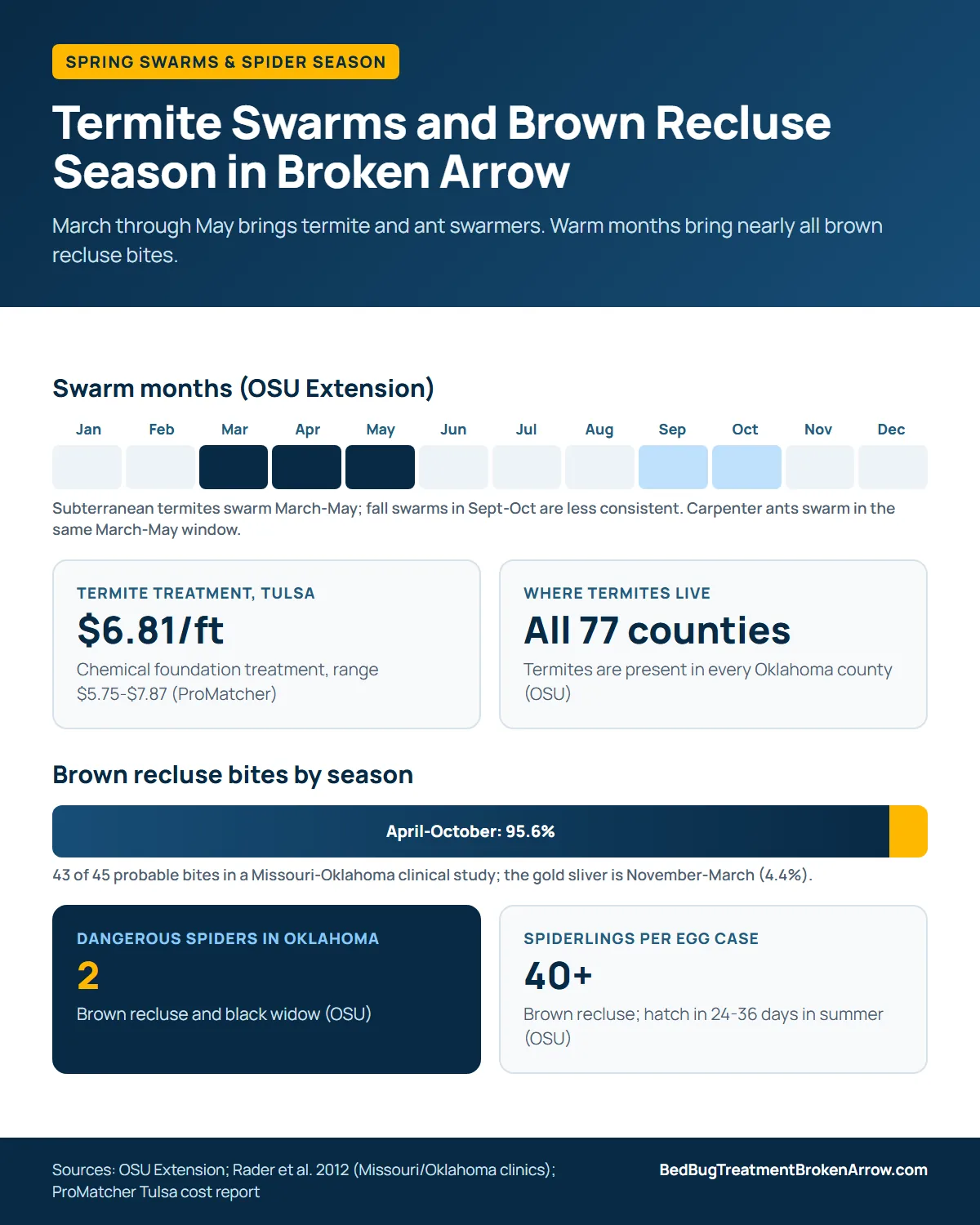
Fire ants follow a similar spring rhythm. OSU says their mating flights happen most often in spring or early summer, one or two days after a rain on warm, sunny days with light wind; flights usually spread colonies a mile or less, but flights of up to 12 miles have been recorded (OSU Extension). OSU draws a clear line: swarmers outdoors are normal because termites live in the soil statewide, but swarmers found inside the house almost certainly mean an infestation. What it means for a Broken Arrow homeowner: spring is inspection season, and termite work is priced and warrantied separately from a general plan. Published termite and general pest prices are collected in our Broken Arrow pest control cost index.
5. When Is Mosquito Season in Oklahoma?
Mosquito season in Oklahoma runs from March to the first frost in November. "Over 60 mosquito species occur seasonally in Oklahoma," and while a few early species prefer cool weather, "the majority of adult mosquitoes are pests during April, May, and June, especially following spring rains" (OSU Extension). In Tulsa, those are the months when normal lows climb from 49.5°F to 68.7°F and May brings the year's heaviest rain.
| Metric | Value | Source |
|---|---|---|
| Mosquito species in Oklahoma | 60+ | OSU Extension |
| Mosquito species in the U.S. | 230 | Oklahoma State Dept. of Health |
| Season length | March to first frost (Nov.) | OSU Extension |
| Peak pest months for adults | April-June | OSU Extension |
| Peak biting time for most species | Just before dark to 2-3 hours after | OSU Extension |
| Mosquitoes carrying West Nile, even where it circulates | Under 1% | OSDH |
| West Nile incubation period | 3-15 days | OSDH |
| First West Nile-positive trap, Tulsa County 2025 | Aug. 1 (later than usual) | Tulsa Health Dept. |
The season can run long. NPMA's Fall & Winter 2026 Bug Barometer forecasts that warm, wet conditions in the South Central region, which includes Oklahoma, could keep cockroaches, ants and mosquitoes active later in the season than usual (NPMA). The Tulsa Health Department sets mosquito traps across Tulsa County every summer and tests them weekly for West Nile virus (THD). The Asian tiger mosquito, which OSU lists among the state's most important species, bites aggressively during the day, so dusk is not the only risky time.
6. Mosquito Barrier Package Costs: Season vs Per Visit
A mosquito barrier package is usually sold as a series of visits across the season. Published prices back the common rule of thumb of about $350-$700 a season or $75-$150 a visit: Fixr puts a full season at $373-$694 (national average $518), and HomeGuide puts a visit at $80-$150, with the first visit slightly higher.
| Service | Price | Source |
|---|---|---|
| Full season of treatment | $373-$694 (avg $518) | Fixr |
| Season package | $350-$1,000 | HomeGuide |
| Per visit, recurring plan | $80-$150 | HomeGuide |
| Barrier spray, per treatment | $70-$150 | Angi |
| One-time event spray | $135-$251 | Fixr |
| One-time treatment, 1/4-acre Tulsa yard (reports dated 2018-2021) | $125.53 ($102.54-$148.51) | ProMatcher |
| Season, lot up to 1/2 acre | $300-$500 | Fixr |
| Season, 1-acre lot | $800-$2,000 | Fixr |
| Misting system install / yearly upkeep | $1,200-$2,500 / $400-$700 | Angi |
Tulsa average for a quarter-acre yard. Good before an outdoor event.
Recurring barrier visits through the warm months.
Install cost, plus $400-$700 a year to maintain.
Timing matters as much as price. Because most adult mosquitoes are pests from April through June (OSU), a package that starts in April covers the peak; one that starts in July misses it. Yard size is the main price driver, so ask whether the quote is for a quarter acre, a half acre or more. ProMatcher's Tulsa averages come from local reports dated 2018-2021, so read them as a floor for 2026 quotes.
7. Tick Season in Oklahoma and Tick-Borne Disease Data
Tick season in Oklahoma runs from early spring to late fall and peaks in early summer. The lone star tick, "the one most commonly encountered by people during recreational activities in Oklahoma," is active from early spring to late fall, and most cases of Rocky Mountain spotted fever (RMSF) in the state occur between April and September, with the peak in May, June and July (OSU Extension).
| Metric | Value | Source |
|---|---|---|
| RMSF case season / peak | Apr-Sep / May-Jul | OSU Extension |
| Share of U.S. RMSF cases from Oklahoma and North Carolina | More than a third | OSU Extension |
| Ticks able to transmit RMSF | Fewer than 1 in 1,000 | OSU Extension |
| Eggs laid by one female lone star tick | 9,000-12,000 | OSU Extension |
| Oklahoma ehrlichiosis rate, 2008-2012 | 30.9 per million (highest in U.S.) | Heitman et al., CDC |
| Oklahoma ehrlichiosis cases, 2008-2012 | 580 | Heitman et al., CDC |
| U.S. average ehrlichiosis rate, same period | 3.2 per million | Heitman et al., CDC |
| RMSF + ehrlichiosis cases reported in Oklahoma, 2017 | 431 | Small et al., citing OSDH |
| Share of U.S. vector-borne disease cases caused by ticks | 75%+ | JMIR Public Health, 2026 |
Not every tick follows the summer curve. OSU notes that adult black-legged ticks become active in late September and October and stay out until March or April, and that in Oklahoma this species is not known to transmit Lyme disease. Scientists believe ticks usually must feed for several hours, and some estimate at least 24 hours, before they can pass on RMSF, so a daily tick check after yard work or a walk on Broken Arrow's trails is the simplest protection.
8. Summer Heat: Cockroaches, Wasps and Crickets
Tulsa averages 74.0 days a year at 90°F or hotter: 14.2 in June, 24.0 in July, 22.2 in August and 9.0 in September (NOAA normals). The station's record high is 113°F, set in August 2011 (NOAA LCD). Heat speeds up insect development, which is why roaches, stinging insects and crickets crowd into late summer.
| Metric | Value | Source |
|---|---|---|
| German cockroach preferred conditions | 85-95°F, 90-95% humidity | PCT |
| U.S. homes seeing roaches in 12 months | 11.3% (about 14 million) | Census AHS 2019 |
| U.S. homes with signs of rats, mice or roaches, 2023 | About 24% | ConsumerAffairs, citing Census AHS 2023 |
| Yellowjacket colony size | Largest in late summer | UW-Madison Insect Lab |
| Wasp nest removal, U.S. average | $525 | Angi |
| Field cricket outbreak months, Oklahoma | August-September | OSU Extension |
| Molts before a cricket nymph reaches adulthood | 8-10 over 2-3 months | OSU Extension |
Crickets are the late-summer surprise. OSU says field crickets "appear in very large numbers during August and September" in some years, usually after a dry spring and early summer followed by rain in July and August; the fact sheet describes a 1953 outbreak in which streets beneath bright lights were black with crickets. Fall invaders follow: in Oklahoma and Texas, multicolored Asian lady beetles that swarm to overwintering sites in autumn usually end up in attics (Noble Research Institute).
9. Brown Recluse Statistics for Oklahoma
"In Oklahoma, only two spiders, the brown recluse and black widow, are considered dangerous to people" (OSU Extension). The brown recluse lives indoors in closets, bedrooms, attics and storage boxes, and most bites happen when someone presses against one, such as when putting on clothes or shoes or rolling over on a spider in bed. Bites follow the warm season closely.
| Metric | Value | Source |
|---|---|---|
| Probable bites occurring April-October | 95.6% (43 of 45) | Rader et al. |
| Bite cases from the Oklahoma City clinic network | 16 | Rader et al. |
| Spiderlings per brown recluse egg case | 40+ | OSU Extension |
| Days for spiderlings to emerge in summer | 24-36 | OSU Extension |
| Healing time for a serious bite | 6-8 weeks | OSU Extension |
| Bites with no reaction or a small red bump | About 90% | Penn State Extension |
| Black widow eggs per sac / sacs per summer | 25-900 / 4-9 | OSU Extension |
A brown recluse hiding in bedding and a bed bug infestation can both start with a mark found in the morning, so it pays to identify the culprit before choosing a treatment. Bed bugs leave rusty spots and shed skins along mattress seams; recluses leave neither.
10. Bed Bug Seasonality: The Summer Surge and Holiday Travel Peaks
Bed bugs live indoors, so Broken Arrow homes can have them in any month. Reports still rise and fall with the seasons. In a study of calls to Philadelphia's health department, bed bug reports "peaked in August and reached a low in February," and after removing that seasonal swing they still rose about 4.5% a month from 2008 to 2012, an almost 70% increase year over year (Penn Medicine via PCT; Mabud et al., Journal of Medical Entomology). The researchers' explanation: warmth makes bed bugs develop faster and move more, and summer travel moves them between homes.
| Metric | Value | Source |
|---|---|---|
| Peak / low month for bed bug reports | August / February | Penn Medicine |
| Monthly growth in reports, 2008-2012 | 4.5% (about 70% a year) | Mabud et al. |
| Share of city pest reports that were bed bugs, Sep 2011-Jun 2012 | 47% (236 of 497) | Mabud et al. |
| Pest pros who get the most bed bug calls in summer | More than half | NPMA |
| Pest pros who treated bed bugs in the past year (2018 survey) | 97% | NPMA |
| Where pros find bed bugs, 2018 survey: single-family homes / apartments / hotels | 91% / 89% / 68% | NPMA |
| Calls first made about a different pest | 84% (mostly fleas) | NPMA |
| Eggs per female: per day / lifetime | 1-5 / 200-300 | OSU Extension |
| Temperature range bed bugs can withstand | Nearly freezing to 122°F | NPMA |
| Oklahoma City, Orkin bed bug cities 2026 | #24 (up 10 spots) | Orkin |
Holiday travel creates the other bed bug peaks. AAA's forecasts show the busiest travel weeks of the year, and each one sends millions of people through hotels, guest rooms and luggage:
What the bed bug calendar means in Broken Arrow
- Summer (June-September): the reporting peak. Warm rooms speed up breeding, and summer trips and college move-outs carry bugs home. Whole-room bed bug heat treatment works in any season, because it heats rooms beyond the 122°F upper limit NPMA gives for bed bug survival.
- Thanksgiving to New Year's: the travel peak. Inspect luggage on a hard surface after a trip and wash travel clothes on hot. OSU's advice for hotel stays is to keep luggage off the bed and check the luggage rack straps.
- January-February: the low season for reports, not for bugs. Infestations brought home over the holidays grow quietly; a targeted chemical treatment plan can start right away.
- Year-round in shared buildings: 89% of pest pros found bed bugs in apartments and condos in NPMA's 2018 survey. Apartment bed bug treatment means checking the units next door too.
- Any season: plan the second visit. Bed bug eggs hatch in 3 to 10 days (OSU), so a follow-up treatment checks for bugs that hatched after the first visit.
11. First Frost and the Winter Rodent Surge in Oklahoma
Tulsa's first 32° freeze arrives on November 3 in an average year, its first hard freeze (28°) on November 14 and its first killing freeze (24°) on November 26 (NWS Tulsa). That is when the National Pest Management Association's best-known winter number comes into play: "rodents alone invade an estimated 21 million homes in the U.S. each winter," and 24% of homeowners report mice specifically in winter (NPMA).
| Threshold | Average last spring date | Average first fall date | Source |
|---|---|---|---|
| 32° frost / light freeze | March 29 | November 3 | NWS Tulsa |
| 28° hard freeze | March 17 | November 14 | NWS Tulsa |
| 24° killing freeze | March 6 | November 26 | NWS Tulsa |
| Metric | Value | Source |
|---|---|---|
| U.S. homes invaded by rodents each winter | About 21 million (estimate) | NPMA |
| Homeowners reporting mice specifically in winter | 24% | NPMA |
| U.S. homes that saw rodents in the past 12 months | 14.8 million (11.9%) | Census AHS 2019 |
| Rodent sightings, homes with leaning or buckling walls | 5.6x more likely | Census AHS 2019 |
| Opening a mouse / rat can squeeze through | Dime / quarter | NPMA |
| Litters per female house mouse per year | 5-10 | ICWDM |
| Rodent inspection and first trap setting, Tulsa (2018-2021 reports) | $140.56 ($133.48-$147.63) | ProMatcher |
| Oklahoma City, Terminix top rodent cities | #43 | Terminix |
Checking the 21 million figure: NPMA's number is an industry estimate of homes "invaded" each winter; it is often repeated as "21+ million," but NPMA's own wording is "an estimated 21 million." The Census Bureau's measured figure is lower: 14.8 million homes, 11.9%, saw rodents at some point in 12 months. Both point the same way, but they measure different things, so this guide labels the 21 million as an estimate.
Mice and rats bring more than droppings. NPMA notes that they spread Salmonella and hantavirus, carry fleas, ticks and lice indoors, and chew wiring, and it recommends storing firewood at least 20 feet from the house and five feet off the ground. For Broken Arrow, the practical window is late October, before the November 3 average first freeze: seal dime-sized gaps around pipes, vents and garage doors while the weather is still mild. The household count comes from Census QuickFacts.
12. A Month-by-Month Pest Prevention Plan for Broken Arrow
Put the matrix to work. This plan turns each season's peak into one task, timed ahead of the pressure rather than after it.
| When | Main pressure | What to do |
|---|---|---|
| January-February | Rodents, indoor bed bugs | Check attics and garages for droppings; inspect beds after holiday guests. |
| March-May | Termite and ant swarms, first mosquitoes | Save a sample of any winged insect found indoors; book a termite inspection; start mosquito service in April. |
| June-August | Mosquitoes, ticks, roaches, bed bug peak | Empty standing water weekly; check for ticks after yard work; inspect luggage after every trip. |
| September-October | Wasps, crickets, lady beetles, late mosquitoes | Seal gaps, screens and door sweeps before the first freeze. |
| November-December | Rodent surge, holiday travel | Set traps along walls by early November; check guest rooms and luggage after Thanksgiving and year-end trips. |
Calls to this line are connected with independent providers across Broken Arrow, from downtown's Rose District to Indian Springs Estates in the south. See every Broken Arrow service area and the full list of bed bug treatment services.
Broken Arrow Seasonal Pest Statistics Summary Table
| Metric | Value | Source |
|---|---|---|
| Hottest month, normal high (Tulsa) | July, 93.6°F | NOAA |
| Coldest month, normal low (Tulsa) | January, 28.0°F | NOAA |
| Days at 90°F+ / nights at 32°F or below, per year | 74.0 / 71.9 | NOAA LCD |
| Wettest month | May, 5.73 in. | NOAA |
| Mean relative humidity, year | 67% | NOAA LCD |
| Average first fall freeze / last spring freeze | November 3 / March 29 | NWS Tulsa |
| Termite swarm months | March-May | OSU Extension |
| Mosquito season / peak | March-first frost / April-June | OSU Extension |
| Mosquito species in Oklahoma | 60+ | OSU Extension |
| Mosquito control, full season / per visit | $373-$694 / $80-$150 | Fixr, HomeGuide |
| One-time mosquito treatment, Tulsa 1/4 acre | $125.53 | ProMatcher |
| RMSF season / peak, Oklahoma | April-September / May-July | OSU Extension |
| Oklahoma ehrlichiosis rate (2008-2012) | 30.9 per million, highest in U.S. | Heitman et al. |
| Brown recluse bites April-October | 95.6% | Rader et al. |
| Field cricket outbreak months | August-September | OSU Extension |
| Bed bug report peak / low | August / February | Penn Medicine |
| Pest pros with most bed bug calls in summer | More than half | NPMA |
| Holiday travelers: July 4th 2026 / Thanksgiving 2025 / year-end 2025 | 72.2M / 81.8M / 122.4M | AAA |
| U.S. homes rodents invade each winter | About 21 million (estimate) | NPMA |
| U.S. homes seeing rodents / roaches in 12 months | 11.9% / 11.3% | Census AHS |
| Tulsa on bed bug / mosquito city lists | #30 (Terminix) / #37 (Orkin) | Terminix, Orkin |
Methodology & Sources
We compiled this calendar in November 2026. Climate figures are NOAA's official 1991-2020 normals for Tulsa International Airport (station USW00013968), downloaded from NCEI, with humidity normals from NOAA's Local Climatological Data and freeze dates from the National Weather Service in Tulsa. Pest timing comes from Oklahoma State University Extension, the Oklahoma State Department of Health, the Tulsa Health Department, NPMA and peer-reviewed studies. The monthly pest ratings in the matrix are our own summary of those sources, not a measured index. Costs are published national and Tulsa-area ranges. ProMatcher's Tulsa prices come from reports dated 2018-2021 and are best read as a floor. NPMA bed bug percentages come from its 2018 Bugs Without Borders survey. Calculations, such as the Broken Arrow rodent estimate, are labeled as ours. We checked the starting figures in our brief: the mosquito package ranges ($350-$700 a season, $75-$150 a visit) match Fixr and HomeGuide, and the winter rodent figure is NPMA's "estimated 21 million," not "21+ million."
- NOAA NCEI -- U.S. Climate Normals 1991-2020
- NOAA NCEI -- 2023 Local Climatological Data, Tulsa
- NWS Tulsa -- Frost/Freeze Climatology
- OSU Extension -- Mosquitoes
- OSU Extension -- Common Ticks of Oklahoma
- OSU Extension -- Termite Swarming Season alert
- OSU Extension -- Carpenter Ant Swarming Season (2017)
- OSU Extension -- Choosing a termite company
- OSU Extension -- Red Imported Fire Ant
- OSU Extension -- Field Crickets
- OSU Extension -- Brown Recluse, Black Widow and Other Spiders
- OSU Extension -- Preventing Bed Bugs
- Oklahoma State Dept. of Health -- West Nile Virus
- Oklahoma State Dept. of Health -- Mosquito Protection
- Tulsa Health Department -- Pest Control
- Tulsa Health Department -- First WNV-positive trap, 2025
- Heitman et al. -- Increasing Incidence of Ehrlichiosis in the U.S. (2016)
- Small et al. -- Rickettsia and Ehrlichia in Oklahoma ticks (2021)
- Maxwell et al. -- Tick-Borne Disease Surveillance in Oklahoma (2026)
- Rader et al. -- Seasonality of brown recluse bites (2012)
- Penn State Extension -- Brown Recluse Spiders
- Mabud et al. -- Bed bug reporting patterns, Philadelphia (2014)
- PCT -- Study reveals seasonal pattern for bed bugs
- NPMA -- Bed Bug Facts & Statistics
- NPMA -- Winter Pest-Proofing Against Rodents
- NPMA -- Rodent Pest Guide
- NPMA -- Fall & Winter 2026 Bug Barometer
- U.S. Census Bureau -- How Many American Homes Have Pests?
- ConsumerAffairs -- 2023 American Housing Survey pest data
- U.S. Census Bureau -- QuickFacts: Broken Arrow city, OK
- ICWDM -- House Mouse Biology
- NC State Extension -- Eastern Subterranean Termites
- UW-Madison Insect Diagnostic Lab -- Yellowjacket Season
- Noble Research Institute -- Ladybug Invasion
- PCT -- German Cockroaches: 10 Key Facts
- Fixr -- Mosquito Treatment Cost
- HomeGuide -- Mosquito Control Cost (2026)
- Angi -- Mosquito Control Service Cost (2026)
- Angi -- Wasp Nest Removal Cost (2026)
- ProMatcher -- Tulsa Pest Control Cost Report
- Terminix -- Broken Arrow common pests
- Terminix -- Top Mosquito Cities
- Terminix -- Top Rodent Cities
- Terminix -- Top Bed Bug Cities (2026)
- Orkin -- 2026 Mosquito Cities
- Orkin -- 2026 Bed Bug Cities
- Orkin -- 2026 Termite Cities
- AAA -- Independence Day 2026 forecast
- AAA -- Thanksgiving 2025 forecast
- AAA -- Year-end 2025 forecast
Broken Arrow Seasonal Pest FAQ
What are the most common pests in Broken Arrow, OK?
Terminix's Broken Arrow branch lists termites, bed bugs, ants, cockroaches and mosquitoes as the most common local pests. Ticks, brown recluse spiders, wasps and rodents also follow strong seasonal patterns. Tulsa ranks #30 on Terminix's 2026 bed bug cities list and #37 on Orkin's 2026 mosquito cities list.
When is mosquito season in Oklahoma?
Oklahoma's mosquito season runs from March to the first frost in November, according to OSU Extension, and most adult mosquitoes are pests in April, May and June, especially after spring rain. Tulsa's average first freeze is November 3.
When is tick season in Oklahoma?
The lone star tick, the one people meet most, is active from early spring to late fall. Most Oklahoma cases of Rocky Mountain spotted fever occur April-September, peaking in May, June and July (OSU Extension). Adult black-legged ticks are active from late September to March or April.
When do termites swarm in Broken Arrow?
Subterranean termites swarm in Oklahoma in March, April and May, with less consistent fall swarms in September or October (OSU Extension). Swarmers outdoors are normal; swarmers inside the house almost certainly mean an infestation.
How many homes do rodents invade in winter?
NPMA estimates rodents invade about 21 million U.S. homes each winter, and 24% of homeowners report mice in winter. In Census survey data, 14.8 million homes (11.9%) saw rodents over 12 months. In the Broken Arrow area, the season starts around Tulsa's average first freeze on November 3.
How much does a mosquito barrier package cost?
A full season of mosquito treatment costs $373-$694, with a $518 national average (Fixr). Individual visits run $80-$150 (HomeGuide), and a one-time treatment for a quarter-acre Tulsa yard averages $125.53 (ProMatcher).
Are bed bugs seasonal?
Bed bugs live indoors all year, but reports follow a seasonal curve. A Penn Medicine study found reports peaked in August and were lowest in February, and more than half of pest professionals say summer brings the most bed bug calls (NPMA). Holiday travel adds smaller peaks around Thanksgiving and the year-end holidays.
When are brown recluse spiders most active in Oklahoma?
In warm months. In a clinical study that included Oklahoma City, 95.6% of probable brown recluse bites happened April-October. OSU Extension says the brown recluse and black widow are the only two Oklahoma spiders considered dangerous to people.
Get Ahead of the Next Pest Season
One call connects you with an independent local provider serving Broken Arrow. Ask about a bed bug inspection after travel, or what seasonal service covers before the next peak. The provider sets the price; there is no obligation to book.